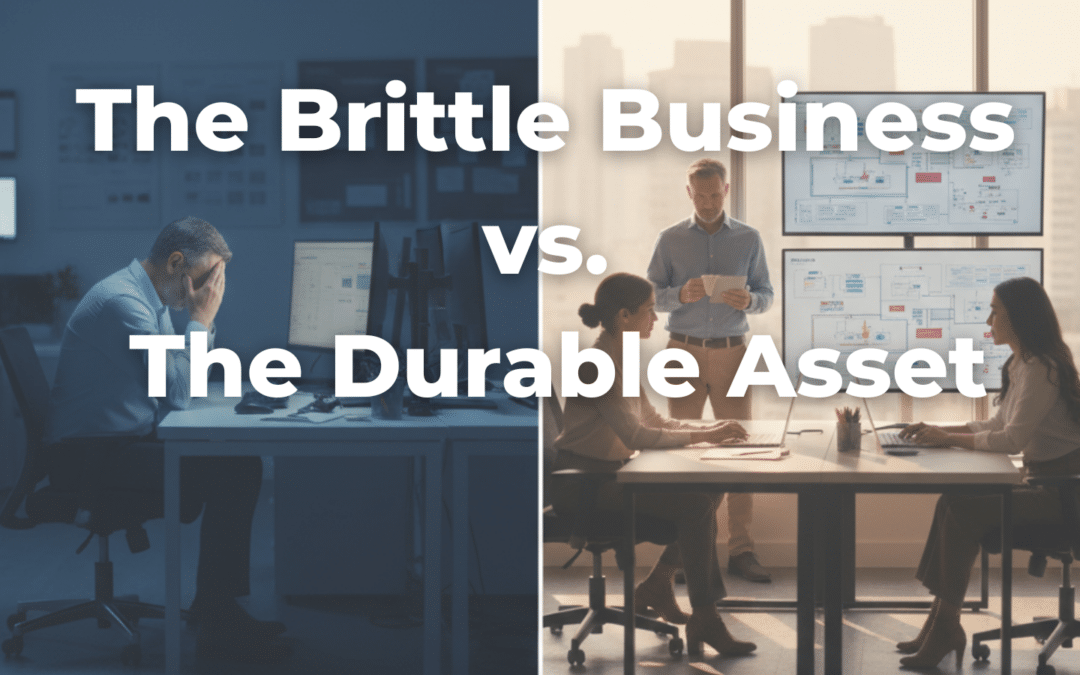
The lights are on at 8:00 PM. The team left hours ago, but the desk is still covered in technical specs, pending approvals, and “urgent” client emails. For many owners of companies in the $2M–$20M range, this is seen as the price of success. In reality, it is a structural failure.
When an owner’s personal “hustle” is the primary engine of the business, the company is Brittle. It may be profitable, but it is high-risk, difficult to scale, and deeply discounted by sophisticated buyers. Building a Durable business, one that operates with professional systems and without owner concentration, is a great way to maximize your freedom and options, whether that’s growing, holding, or planning your next chapter.
Is Your Business Brittle or Durable?
A Brittle business relies on “Hero-Operators” to save the day. A durable business relies on systems to ensure the day never needs saving. Assessing your operational reality requires looking at how complexity and risk act as a hidden tax on your company’s value.
| Risk Factor | Brittle (Owner-Dependent) | Durable (System-Dependent) |
| Problem Solving | Owner is the Chief Firefighter. | Team uses a Decision-Making Filter. |
| Sales & Growth | Relational; depends on the owner. | Structural; lead-gen is a repeatable process. |
| Knowledge | Tribal; expertise is trapped in heads. | Architectural; documented and redundant. |
| Customer Mix | High concentration (one client > 15%). | Diversified; no single point of failure. |
| Operations | “Emergency-as-a-Culture.” | “System-as-the-Hero” (Predictable Cadence). |
The transition from Brittle to Durable is not just a time-management exercise; it is an operational shift that requires moving your business from a “Hero” culture to a “System” culture.
The Financial Reality: The Multiple Gap
In the private market, buyers do not just buy EBITDA; they buy the certainty of future cash flows. If those cash flows are tied to your personal presence, the risk is too high. This creates a “Multiple Gap” that can cost owners millions in personal wealth.
Consider two companies with identical financials ($2M EBITDA):
- The Brittle Company: The owner is the primary salesperson and lead technical architect. A buyer sees significant Transferability Risk. They offer a 3x multiple. Enterprise Value: $6M.
- The Durable Company: The owner provides oversight but is decoupled from daily operations. The business has documented redundancies and diversified revenue. A buyer sees an auto-pilot asset. They offer a 6x multiple. Enterprise Value: $12M.
The difference, the Durability Premium, is $6M. Building a business that doesn’t need you is the single most profitable activity you can undertake.
The Decision: Three Operational Shifts
To eliminate owner concentration and build a foundation for sustainable growth, leadership must implement three specific structural changes.
I. The Knowledge Transfer
Tribal knowledge is the enemy of scale. When processes exist only in the minds of “tenured” employees or the owner, the business cannot grow without adding layers of expensive, unmanaged complexity.
- The Activity: Move from “Tribal Knowledge” to Standard Operating Architecture.
- The Goal: Document the top 20% of activities that drive 80% of your results. These must be robust enough that a new hire can execute them to a “B+” level without asking for your input.
II. The Decision-Making Filter
Most owners are the bottleneck because they have trained their team to escalate every problem. This keeps you in the weeds and keeps the team from developing.
- The Activity: Implement a framework where the team solves 90% of problems without escalation.
- The Shift: Define procedures and policies for spending and decision-making. When a team member asks for a solution, don’t give it. Ask: “How would you handle this if I were on a boat in the Mediterranean?”
III. The Stress Test
A durable business must be able to withstand the absence of its leader. Most owners wait for an external crisis (illness, vendor loss, or market shift) to find their breaking points.
- The Activity: Conduct a Disruption Audit. Step away from the business for one full week—no email, no Slack, no “just checking in.”
- The Result: Identify exactly where the gears ground to a halt. Those friction points are your strategic roadmap for the next quarter. If the business shatters, it is better to break it in small ways now than to have it fail during a due diligence process later.
The Stakes: Choosing Optionality
The goal of building a Durable business isn’t just to sell. It is to achieve optionality. A business that is decoupled from its owner allows for three paths:
- Scale: You can grow at a smooth, comfortable pace or aggressively (depending on preference and your business’ financial condition) because the systems support the weight of new volume.
- Freedom: You retain ownership and take distributions while regaining your time to focus on high-level strategy or other ventures.
- Exit: You exit on your own terms for a premium multiple because you are handing over a machine, not a set of keys to a chaotic office.
The “Hero-Operator” status is not a badge of honor; it is a liability. The transition to a durable business is the only path to a company that works for you, rather than you working for it.
Schedule Your Clarity Conversation
Your “hustle” has taken the business this far, but it is the very thing preventing you from reaching the next level of value. If you are ready to stop being the bottleneck and start building a Durable Asset, let’s identify the specific friction points in your current operation.
In this 20-minute Clarity Conversation, we will:
- Pinpoint the “Hero-Operator” traps currently limiting your company.
- Identify the two highest-impact areas you need to get freedom from in daily operations.
- Outline a high-level strategy to increase your multiple by reducing transferability risk.
Book Your Clarity Conversation